


Trip report
Upping the ante in Latin America
It’s been six years since FertiGlobal took its first tentative steps into Latin America. We knew back then that the acquisition of Agrigento Fertilizantes would mark the beginning of something special…and so it has proved to be, as Laura Galli – FertiGlobal’s Global Marketing Director – discovered during her recent visit.
We always banked on EnNuVi being the flagship Technology here. Brazilian farmers are well-informed and hungry for innovation – understandably, EnNuVi’s bioactivating properties, demonstrated through sound science, captured their interest immediately.
We’ve said before how we found Brazilian farmers often as well informed as their counterparts in North America and Europe. And this year we used that enthusiasm and familiarity as a lever – hosting the first LATAM EnNuVi Ambassadors’ Meeting.
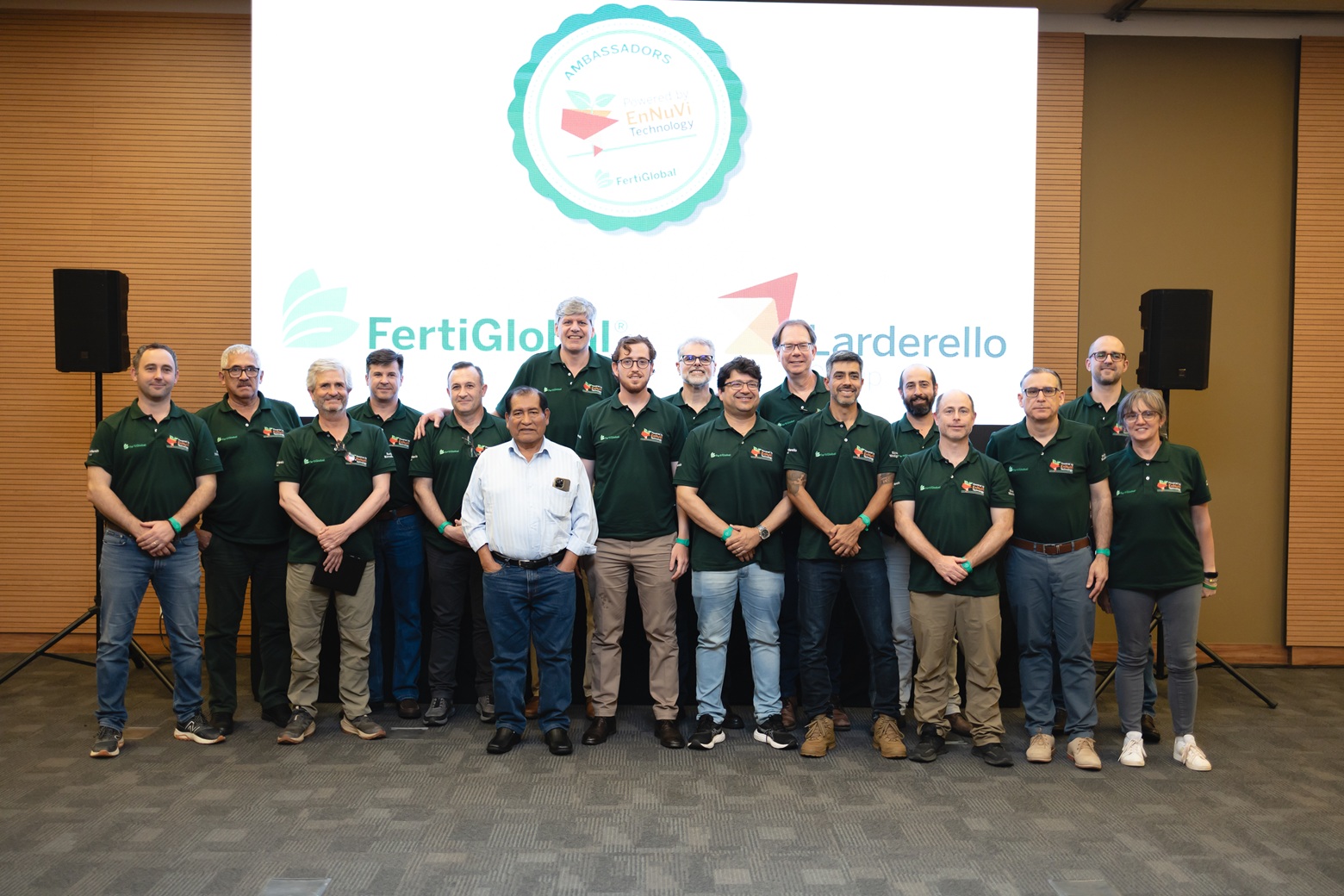
I don’t use the term ‘turning point’ lightly – but that’s exactly what this was, drawing on scientific and technical collaboration to deliver a clear and ambitious route through the topic of plant bioactivation.
Bringing together 12 distinguished advisers and researchers from across the region – not just Brazil, but also Argentina, Chile, Peru and Paraguay – the two-day event was wide-ranging, taking in annual crops, vegetables, fruit trees, yerba mate, coffee and tea.
Global knowledge, local focus
Cerquilho, in Sao Paolo state, is FertiGlobal’s powerhouse in Brazil. Here lies the plant, the lab and the office – the three essentials for our success. In keeping with our commitment to global quality and consistency, all manufacturing takes place at the Larderello plant in Italy – here in Brazil, the products are received inbound in IBCs, to be made up into EnNuVi Technology-based products for distribution.
Lab work comprises quality control too, but also a sizeable R&D activity to provide for local needs. With the speed at which the Brazilian market is moving, coupled with the favourable regulatory environment – government policy is encouraging adoption of more sustainable methods and inputs – it’s vital that we can keep up to speed with local developments and opportunities.
Such examples were masterfully explained by Ricardo Wolfgramm, FertiGlobal Brasil marketing manager. Products like Strato, Assoluto, Camen, Veloce, Galle – each of these products has been developed by the FertiGlobal Brasil team to meet a need identified through local experience. Such is their suitability and applicability to local conditions that they are now rolling out into South and Central America too.

But of course the plant and the lab – they’re only as good as the products they turn out, which in turn are only as good as the results they yield. Our entire strategy in Brazil is about the farmer, so how do we reach the farmer? Through demonstration farms that allow us to explain what makes a product right for a given situation, its agronomic efficiency, and its comparison with conventional programmes. Total Crop Management, in action.
Coffee Colossus
If you didn’t know already, Brazil is the world’s largest producer of coffee. More than one-third of the world’s coffee – around four million tonnes a year – is grown in Brazil. Arabica and Robusta, the two major coffee varieties, thrive in the Brazilian climate; its coffee is favoured for low acidity and its nutty, chocolatey taste.
So, when visiting Brazil, where better to take a Global Marketing Director than coffee plantations?
Nossa Senhora da Conceição e Progresso is well-known to FertiGlobal, being the location of a major ongoing trial with one of the world’s most famous coffee brands. The operation uses FertiGlobal products on nearly a quarter of its planted area, the resultant coffee fully certified for sustainability, and remarkable for its autonomy: from product applications to harvest and processing, the whole sequence is automated.

Fazenda Jambeiro, in contrast, combines coffee production with dairy and poultry enterprises, but its claim to fame is longevity: some of its oldest plantations are 45 years old, producing sought-after beans that are regarded as amongst the highest quality on the market. Measured using the Specialty Coffee Association’s ‘cupping score’ – an aggregation of 10 attributes – a figure of 80 or above qualifies the beans as ‘specialty grade’. Fazenda Jambeiro? Scores of 90, regarded as exceptional.

Sugarcane: more than sugar
It’s not just coffee for which Brazil ranks top of the charts. The country also enjoys its status as the world’s top producer and exporter of sugarcane. Yet it’s not all about sugar: besides the many industrial uses for sugarcane, such as ethanol and bioplastics, Brazilians also take pride in using sugarcane juice to produce their national drink, cachaça.
Often described as ‘rum’s cousin’, national production of cachaça is around 1.3 billion litres a year – and just 1% of that is exported; Brazilians want to keep it to themselves! Nevertheless, in a bid to try to help the Global Marketing Director find the true ‘essence’ of Brazilian agriculture, the team laid on a visit to Escola Superior de Agricultura “Luiz de Queiroz”, in Piracicaba, to learn about the production of this famed spirit.
It’s one of nearly 1,300 cachaça producers nationwide, together responsible for more than 7,000 different product registrations: cachaça comes in many varieties, from the unaged ‘white’ to countless wood-aged specialities, some of which may lay in the barrel for up to 18 years.


With such a multitude of tastes and flavour profiles, it’s no wonder Brazilians have coined more than 2,000 words to describe it: everything from abre-coração (heart-opener) and água-benta (holy water) to bafo-de-tigre (tiger breath) and limpa-olho (eye-wash)!
After caipirinhas all-round, the following day it was time to get down to more business with our EnNuVi Ambassadors. A short introduction from Gustavo Branco, CEO of FertiGlobal Brasil, set the scene for Claus Brakemeier, Business Development Manager, to explain more about the principles underpinning EnNuVi Technology.


We were also pleased to host Professor Fabricio Rodrigues of Viscosa University, Prof Jorge Llontop and Prof João Ascari, who between them presented – to great interest – the scientific rationale behind EnNuVi and how it translates into real results in the field.


In short, a terrific inaugural EnNuVi Ambassadors’ Event. Not only could we demonstrate the positive effect of EnNuVi Technology on agricultural productivity and sustainability, but also benefit from an open exchange of experiences – the challenges, insights and lessons that they brought from their own agricultural contexts.
Its legacy is a network of experts across LATAM committed to agricultural innovation, and a reaffirmation of FertiGlobal’s leadership in developing sustainable solutions. It’s something we hope to repeat in further regions.